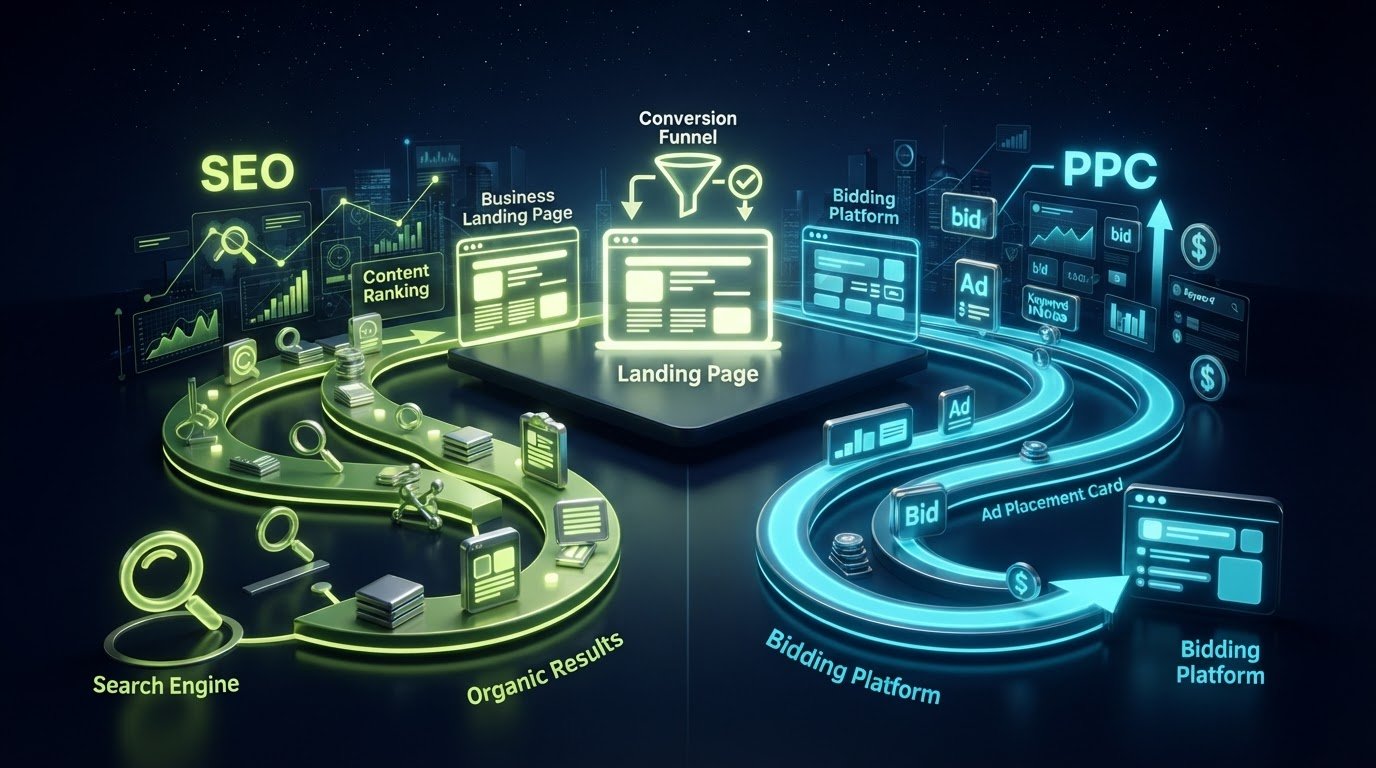
SEO and PPC both help businesses reach people who search, but they operate differently. SEO aims to earn visibility in unpaid results with relevant, accessible pages. Pay-per-click advertising purchases eligible ad exposure through a platform’s auction and campaign settings. A strong search strategy gives each channel a role rather than assuming one channel improves the other’s ranking.
This guide shows how organic search, Google Ads and broader search engine marketing can share keyword insights, landing-page improvements and measurement. It also explains what the relationship does not mean: paying Google for ads does not buy a better position in the organic search results.
Start with the buyer journey rather than channel names
A customer may search for an explanation, compare options and later look for a provider. Some queries are informational and better served by a tutorial; others are commercial and may justify a paid campaign or a detailed service page. Map the stages before allocating a budget. An article about repair costs is a different asset from a campaign aimed at people ready to book an appointment.
For each stage, record the searcher’s likely question, the best landing page, and what counts as a useful action. A brand-new service might need paid visibility while its organic content develops. An established informational library may attract steady visitors without paying for every click. The right combination depends on economics and audience needs, not a fixed percentage split.
What the paid search auction actually does
Google Ads uses an auction and Ad Rank considerations to determine eligible ad positions. Bids, ad relevance, landing-page experience and search context all influence outcomes. A higher bid does not guarantee that an ad will always appear first. It is a different system from the organic results ranking process.
When creating a campaign, check which keywords trigger ads, what the ad promises, and whether the landing page delivers that promise. A paid visitor deserves accurate prices, functioning forms and a relevant answer. Avoid sending every ad to a generic homepage when a specific service page would better satisfy the search.
Use PPC search terms to learn about intent
A campaign’s search term and conversion reports can indicate which buyer questions lead to useful actions. That information may inspire a better product page, buying guide or service explanation for organic search. But paid conversion success does not prove an article will rank in organic results, nor does it establish a precise search volume for a different country.
Look for repeated themes, not only individual phrases. If customers regularly ask about delivery time or technical compatibility, make that information easier to find on your site. Then use Search Console to see whether relevant pages receive impressions for those topics. The two datasets answer different questions and should not be merged indiscriminately.
Use organic search reports to improve paid targeting
Search Console may reveal a growing group of queries around a useful product or service. Paid campaigns can help test different offers where a business is prepared to pay for qualified visits. However, the fact that a page receives organic impressions does not automatically make the same phrase profitable for ads.
Review conversion value, acquisition cost and lead quality before expanding budgets. A keyword bringing ten qualified customers is more useful than one bringing many low-intent clicks. For local services, geographic relevance and the ability to fulfill requests are especially important. Don’t advertise in markets where you cannot support customers.
Improve landing pages for both channels
Clear navigation, a descriptive heading, accurate offer details and working contact forms help people regardless of how they arrived. Technical SEO improvements can make a site easier to crawl and use, while UX improvements can reduce confusion for paid visitors. This shared website work is often the strongest practical connection between SEO and PPC.
Keep the message consistent with the query and advertisement. If an ad offers a free consultation, do not send the visitor to a page that hides the appointment process. If an informational article is meant to educate, don’t cover it with a giant sales pop-up. Test mobile performance and form submission behavior before increasing traffic.
Understand overlap and cannibalization carefully
A site can have an ad and an organic result visible for related searches. This does not prove that the ad stole an organic click or increased organic ranking. Assess incremental results by examining campaign and organic data together. Attribution is complicated when the same person returns through multiple channels.
Avoid strong conclusions from a week of changing impressions. Paid advertisements can increase brand awareness and may influence branded search demand later, but that is different from ads directly affecting Google’s organic ranking algorithm. Keep notes on campaign launch dates so changes in branded queries are not mistaken for a technical SEO win.
Make SEO and SEM terminology explicit
SEO usually refers to unpaid search optimization. PPC describes a payment model used in different ad systems. SEM is used differently by organizations: some teams use it for paid search, while others use it as an umbrella term for search marketing. Define the term in your reports rather than arguing that only one usage is possible.
Google Ads was formerly widely referred to as AdWords, so queries such as ‘SEO and AdWords together’ usually concern the same practical relationship between organic search and search advertising. Modern advice should use current platform terminology and separate paid campaign reports from organic performance.
Create a shared reporting dashboard without blending metrics
Put organic clicks, landing pages and search queries in one clearly labeled section. Put paid impressions, spend, clicks, acquisition cost and conversions in another. Then add business outcomes such as real appointments or purchases. Compare similar dates and countries, and document the attribution method used.
An organic click is not the same as a paid click or a GA4 session. Ad platforms and analytics can record events differently, especially with consent restrictions or cross-device behavior. Verify the tracking setup and avoid adding numbers together when they represent overlapping visits. Useful reporting should clarify the business decision, not inflate a growth headline.
A modest ninety-day coordinated plan
First month: audit the site, verify tracking, map buyer queries and improve important landing pages. Second month: publish a small set of original resources while testing limited paid campaigns against clear offers. Third month: compare qualified leads, costs and search visibility, then adjust content priorities or budgets accordingly.
The purpose of this sequence is learning, not a guarantee that SEO will generate a specific ranking within ninety days. A service business with an urgent pipeline goal may rely more heavily on paid search initially. A publisher focused on AdSense may put more effort into helpful informational content. Make the choice based on measured performance.
Frequently asked questions
Does buying Google Ads improve organic ranking? No direct organic placement is purchased. Can both channels target the same query? Yes, when the intent and economics justify it. Should a small business stop PPC once SEO starts? Not automatically; assess qualified results and cost. Is SEM the same as PPC? The terms overlap in common usage but should be defined in context.
Can paid campaigns provide content ideas? Search terms and buyer questions can be informative, while organic intent still needs its own research. Does a good SEO page guarantee a high ad quality score? No. A useful landing page may support both efforts, but each system evaluates performance under different criteria.
Official resources
Continue with a practical example
If you are evaluating your own website, read the related guide on eshohan.com and document the change you plan to make. For implementation questions, the contact page provides a direct route to ask about a review. Do not treat any checklist as a ranking guarantee.