Search engine optimization, usually called SEO, helps a website become easier for search engines to discover and understand and more useful to people searching for information. It combines technical website work with good writing, thoughtful structure, and measurement. You do not buy placement in Google’s organic results. You make the best case that your page deserves to answer a particular question.
For someone asking what SEO is and how it works, the most useful starting point is the path from publishing a page to appearing in search. This guide explains that path, shows where keywords fit, and gives you a practical plan you can use on a small business site, WordPress blog, or online store.
What is SEO?
SEO stands for search engine optimization. Suppose a homeowner searches for ways to stop a leaking tap. A useful article might explain how to locate the leak, which tools to prepare, and when to call a professional. SEO helps communicate that subject clearly through the article’s title, content, navigation, links and technical settings. It also makes the page accessible to both the reader and search crawlers.
SEO is different from paid search advertising. Organic listings do not charge a fee each time somebody clicks them. The website owner may still pay for content, hosting, expertise, or tools. And appearing in organic results is never automatic: Google chooses which pages to include and how to present them.
How Google Search works: crawl, index, serve
Crawling: finding and fetching a page
First, a search engine has to discover a URL. Google can find URLs through links from known pages and sitemap files. Its automated systems then request the page and may render the content. If the server is unavailable, important pages are hidden behind scripts, or links lead to errors, discovery and crawling can suffer.
A sitemap is a helpful map of intended URLs, not a guarantee of indexing. The more practical test is whether people and crawlers can reach your important pages through normal navigation. Fix broken links, ensure your site returns successful responses, and make related pages discoverable without relying entirely on a site search box.
Indexing: understanding and selecting content
After crawling, Google analyzes the page’s text, images, headings and other signals. It may decide that another URL is the canonical version when multiple pages show substantially similar content. Pages can also be excluded because of noindex settings or other issues. A published page is therefore not necessarily an indexed page.
Give each page one clear subject and purpose. A descriptive title, useful opening answer, sensible headings and relevant internal links help explain the material. Avoid creating several pages that repeat the same explanation with only a few words changed. For technical detail, read Google’s explanation of crawling, indexing and serving.
Serving results: matching the searcher’s need
When someone searches, Google selects pages it believes are relevant and useful for that query. Results can vary with the wording, location, language and device. Someone searching ‘SEO checklist’ probably wants steps to follow, while someone searching ‘SEO consultant for Shopify’ may want a specialist’s service page. The right format depends on the intent.
There is no hidden number of keyword mentions that guarantees a result. The page must satisfy the actual question, be accessible, and offer reliable information. Google explicitly says that meeting its guidelines does not guarantee a page will be crawled, indexed or served.
The main types of SEO work
Technical SEO
Technical SEO removes obstacles that prevent search engines and visitors from using your site. Work includes HTTPS, mobile rendering, site navigation, canonical URLs, redirects, server responses, XML sitemaps and robots rules. Core Web Vitals are useful performance diagnostics, but speed alone cannot compensate for poor answers. Start with confirmed access or indexability problems rather than changing every setting at once.
For example, if a service page accidentally carries a noindex directive, making the article longer will not solve that technical exclusion. A practical technical SEO review should identify that problem before recommending content rewrites.
On-page SEO
On-page SEO improves what the page says and how it is organized. It covers titles, headings, the answer itself, image descriptions and links to related material. A product page should help somebody buy the right product; a tutorial should explain how to complete a task; a comparison should show meaningful differences. Those are different jobs, and writing should reflect them.
Use headings to separate ideas, add examples wherever they clarify a decision, and avoid repetitive keyword lists. Helpful alt text describes what an image shows. A meta description summarizes the page honestly; Google may choose another snippet if it better fits the search. The goal is comprehension, not filling every field with phrases.
Content planning and authority
A focused site can build a connected set of useful articles. For example, one page could explain what SEO means, another could teach a website audit, and another could show how to measure results. Link them when a reader would naturally benefit. This is more useful than publishing six versions of ‘how to SEO my website’ with nearly identical instructions.
Trust also matters. Attribute work accurately, support important claims with reliable sources, correct outdated guidance, and include genuine examples when you have them. Links from other websites may help people discover your material, but buying bulk backlinks or inventing testimonials creates needless risk. Google’s helpful content guidance offers practical questions for judging the value of a page.
How SEO works for a business
Consider a local air-conditioning repair company. One potential customer searches ‘why is my AC leaking’, another searches ‘AC repair cost’, and a third searches ‘AC repair near me’. The first visitor needs troubleshooting, the second wants pricing context, and the third may be ready to contact a provider. One generic landing page is unlikely to serve all three equally well.
A business can publish a helpful troubleshooting guide, a transparent explanation of pricing factors, and an accurate service page for its real area. That gives people the information appropriate to each stage. The relevant outcome might be a call or booking, not simply another pageview. For organizations that need implementation support rather than a tutorial, ScaleKin’s digital marketing services provide a separate route to explore professional help.
A practical eight-step SEO starting plan
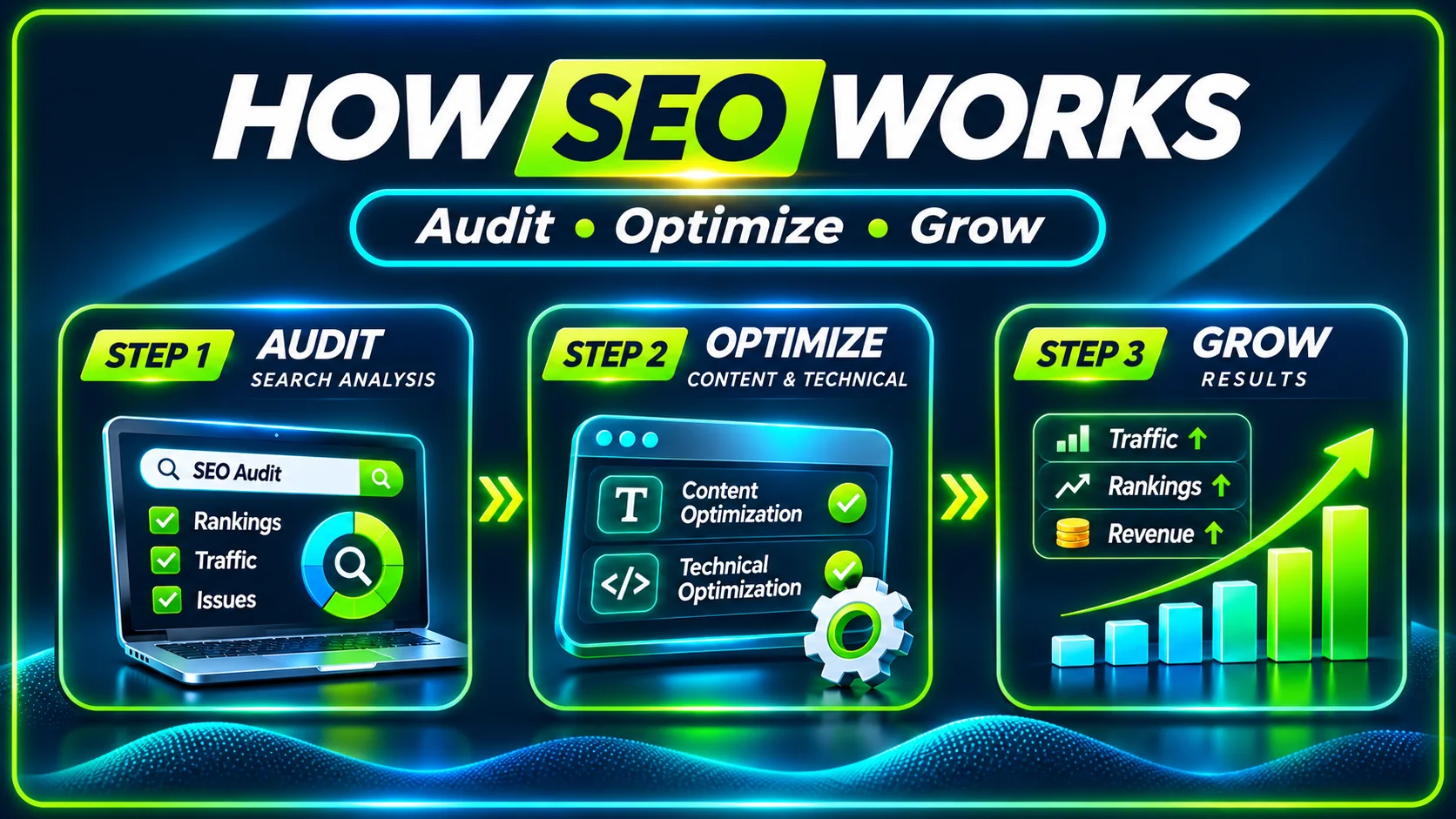
Step 1: List your important pages and decide what a successful visit means for each one. A store might care about purchases; a consultant might care about qualified inquiries. Step 2: Inspect those URLs for crawl, indexing, and canonical issues in Search Console where you have access.
Step 3: Research what the reader searches and what type of answer appears in the target market. Step 4: Assign each major URL a distinct primary question instead of competing with yourself. Step 5: Write a clear title and opening paragraph that state exactly what the page offers.
Step 6: Improve the body with useful explanations, screenshots or examples, headings, and descriptive alt text. Step 7: Connect related pages with links that explain where they go. Step 8: Record the changes and review search visibility and meaningful business outcomes over several weeks.
Do not treat this sequence as a rigid recipe. A new blog needs a different starting point from a shop with ten thousand products. If the main problem is duplicate catalog URLs, the first task may be technical. If users are finding your service page but leaving without contacting you, usability and offer clarity deserve attention.
How do you measure whether SEO works?
Google Search Console reports impressions, clicks, queries, pages and related dimensions for Google Search. Those numbers tell you about search visibility and traffic, but not every action a visitor takes after landing. A separate analytics platform can help measure engaged sessions, inquiries or sales if tracking is configured correctly. Compare similar periods and consider seasonality, brand campaigns and new content when interpreting change.
A rise in impressions without more clicks may mean search visibility is growing but the page is rarely selected, or it may reflect appearances for less relevant queries. A rise in organic visitors without more useful actions may signal a mismatch between the article and the business objective. Look at the page and query together before deciding what to change.
Common beginner mistakes
Avoid using keyword density as your main quality test, assuming every published page is indexed, copying competing articles, changing slugs without redirects, or treating an SEO plugin score as a promise. Do not claim that adding structured data guarantees rich results. Google’s SEO Starter Guide is explicit that improvements can take time and that no method guarantees first position.
Another mistake is confusing volume with relevance. One hundred visitors who need a service may be more useful to a small business than ten thousand visitors who searched an unrelated celebrity’s name. Make content choices around a real audience, not just a search tool’s largest numbers.
Frequently asked questions
Is SEO free?
Organic clicks do not carry a per-click fee from Google, but SEO work consumes time and can involve paid tools, writers, developers, designers or consultants. Separate these costs from advertising spend.
Can I do SEO myself?
Yes. A site owner can improve titles, article clarity, internal links and basic setup. More difficult migrations, JavaScript rendering problems or catalog indexing issues may require specialist development and testing.
How many keywords does one page need?
There is no universally correct count. Start with one principal search intent and use natural related terms as needed to answer it. Separate pages are justified when the reader’s goals or required information differ.
How quickly will SEO work?
Some changes can be reflected in search within hours or days, while meaningful growth may take months or may not occur. Competition, crawl patterns, website history and content quality all affect the outcome. Record your baseline so you can judge progress rather than guess.
Where to go next
Pick one important URL and check whether it is accessible, clear about its subject, and useful to the intended visitor. Those are better first priorities than any promise of instant ranking. For an independent review, explore the SEO services on this site or send a project inquiry.